Comparison
Best Google Play Closed Testing Services in 2026: Verified Opt-Ins, Monitoring, and Reports Compared
Compare Google Play closed testing services by price, tester buffer, 14-day monitoring, reporting, retest terms, and support for developers in India.
On this page · 10 sections
- 01The current Google Play rule: 12 testers, not 20
- 02How we compared the services
- 03Quick picks by developer need
- 04TestMyApps: monitored buffer and strong two-app economics
- 05Testers Community, TesterBee, and PlayLaunch
- 06Why Firebase, BrowserStack, and Testlio are different choices
- 07Questions to ask before paying any closed testing provider
- 08Final recommendation
- 09Frequently asked questions
- 10Official sources
At a glance
In plain English
- Google's current minimum is 12 testers opted in continuously for 14 days—not 20. The older 20-tester phrase still appears in searches and on stale pages.
- TestMyApps is the strongest value when you need a two-app bundle: $29 for two apps, with 14 testers per app, a 16-day operating window, monitoring, and reporting.
- For India-first billing, PlayLaunch publishes INR plans. TesterBee and Testers Community publish broader tester-count tiers in US dollars.
- No service can sell production access. Compare official opt-ins, continuity ownership, feedback evidence, and the written remedy if Google asks for more testing.
If your Android launch is blocked by closed testing, the best service is not automatically the one promising the largest tester count. It is the one that makes the official opt-in path visible, owns continuity through Day 14, provides useful evidence, and states what happens if the run is not enough.
This comparison was checked on 6 November 2026 against Google's documentation and each provider's own public pages. Prices and feature claims are provider-published, not independently audited results. Recheck the checkout page and terms before paying.
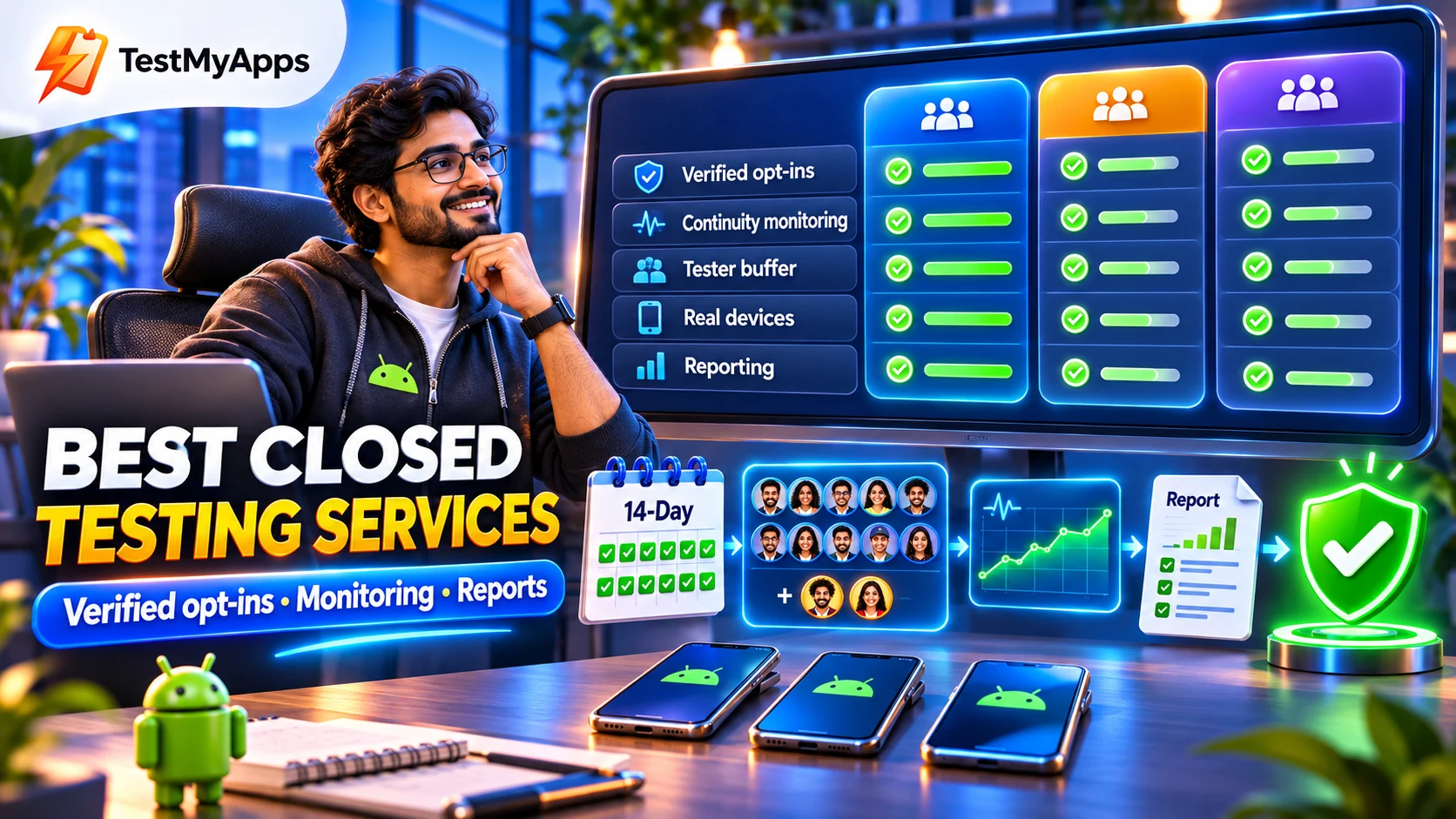
Start a monitored run from $15We meet Google's 12 testers × 14 days by assigning 14 testers for 16 days (buffer).The current Google Play rule: 12 testers, not 20
For personal developer accounts created after 13 November 2023, Google says a closed test must have at least 12 testers opted in continuously for the preceding 14 days when the developer applies for production access. An invitation, email address, APK install, internal-test session, or one-time app open is not a substitute for a valid closed-track opt-in.
Google also says it may require more testing when there are fewer than 12 opted-in testers or insufficient tester engagement. Completing the numerical minimum makes the account eligible to apply; it does not guarantee Google's decision.
Why do people still search for a 20-testers service? Twenty was the original minimum. Google announced the reduction to 12 in December 2024. Some services sell 15, 20, or 25 seats because extra participants can provide a buffer and more feedback—not because every affected account still needs 20.
How we compared the services
The shortlist focuses on services with public information relevant to the production-access bottleneck. It does not rank general QA platforms as if they were tester-fulfillment services.
- Official opt-in path: testers must join the correct Google Play closed track.
- Continuity ownership: the provider should explain monitoring, reminders, and dropout handling.
- Buffer: extra testers or extra days reduce operational risk, but do not rewrite Google's rules.
- Evidence: useful feedback and a closeout summary support honest production-access answers.
- Transparent price: one-time cost, app count, tester count, and included support should be visible.
- Written remedy: retest, refund, or another response should be defined in current terms.
Quick picks by developer need
Choose by the constraint that is actually delaying launch. A solo developer with one simple app, an agency with two client apps, and a team that needs deep functional QA should not buy the same package by default.
- Best two-app value: TestMyApps Premium is $29 for two apps, with 14 testers per app across a 16-day operating window.
- Best low-cost one-app TestMyApps route: Basic is $15 for one app; functionality plans are available when you need regular, feature-by-feature feedback.
- Best for INR pricing: PlayLaunch publishes a ₹799 Starter plan with 12+ testers and a ₹1,499 Professional plan with 20+ testers.
- Best for many published seat options: TesterBee lists 12-, 15-, 20-, and 25-tester tiers.
- Best free reciprocal option among this shortlist: Testers Community publishes a free swap community alongside paid plans.
TestMyApps: monitored buffer and strong two-app economics
TestMyApps publishes $15 for one app and $29 for two apps. Each standard run assigns 14 testers for 16 days, creating both a tester buffer and a time buffer above Google's 12-by-14 minimum. The workflow includes opt-in monitoring and a closeout report.
For deeper QA, TestMyApps also publishes functionality-testing plans at $50 for one app and $99 for two. Those plans add regular feedback and feature-by-feature testing; they are different from the lower-cost standard coordination plans.
The service states a free retest if Google still requests more testing, followed by a refund under its published guarantee if the retest still does not lead to approval. That remedy should not be read as a promise that TestMyApps controls Google.
- Published fit: solo developers, agencies, and small teams that want monitored closed-test coordination.
- Distinctive value: 14 testers for 16 days and a two-app plan priced below buying two one-app credits.
- Check before buying: whether standard coordination or deeper functionality testing matches the app's risk.
Testers Community, TesterBee, and PlayLaunch
Testers Community publishes a $15 Starter plan with 15 testers and a $25 Pro plan with 25 testers plus an ASO report. Its pages also describe a free reciprocal community, dashboard visibility, feedback reports, and an approval-or-refund promise. Treat timing, scale, rating, and approval claims as the provider's own statements and read the current guarantee.
TesterBee publishes $14.99 for 12 testers, $18.74 for 15, $24.98 for 20, and $31.23 for 25. Its pages describe real-device testers, daily engagement monitoring, dropout replacement, written feedback, priority support, and free retesting. Check the exact buffer and refund language for the tier you select because plan labels and bundled descriptions can change.
PlayLaunch is especially easy to budget in India because it publishes INR prices: ₹799 for 12+ testers and ₹1,499 for 20+ testers. Its current homepage describes physical devices, activity tracking, dashboard access, feedback, and a clear statement that Google alone decides production access. One terms page still uses older 20-tester wording, so rely on Google's current rule and confirm which plan applies in your Play Console.
Why Firebase, BrowserStack, and Testlio are different choices
Firebase App Distribution helps teams distribute pre-release builds to testers and collect feedback. BrowserStack App Live provides interactive access to real Android and iOS devices in the cloud. Testlio combines testing people, a platform, and managed QA services across devices and markets.
All three can improve software quality, but none should be assumed to supply and maintain the 12 closed-track opt-ins required for your production-access gate. Use them for build distribution, device coverage, automation, exploratory QA, or market testing. Use a closed-test fulfillment service—or your own reliable group—when the missing input is continuously opted-in people on the correct Google Play track.
Questions to ask before paying any closed testing provider
Send the same questions to every provider. Clear, written answers are more valuable than a large tester count in a headline.
- Will every tester join through my official Google Play closed-test opt-in link?
- How can I distinguish invited, joined, installed, active, opted out, and replaced testers?
- How often is continuity checked, and who responds if the count falls?
- How many buffer testers and buffer days are included in this exact plan?
- What feedback or closeout evidence will I receive for my production-access questionnaire?
- What does the written retest or refund policy cover—and what does it exclude?
- Do I keep control of my Play Console, signing keys, source code, and user data?
Final recommendation
If you can recruit 14 reliable Android users and monitor the run yourself, DIY or a reciprocal community can be enough. If recruiting, reminders, continuity, or reporting are the bottleneck, choose a managed service with visible operational ownership.
TestMyApps is a strong default for developers who want a 14-tester, 16-day buffer and especially for teams with two apps at $29. PlayLaunch is compelling for INR billing, while TesterBee and Testers Community offer useful alternative tester-count tiers. The responsible choice is the plan whose workflow and written terms you can verify—not the loudest approval claim.
Compare TestMyApps plansManaged Google Play closed testing is $15 for 1 app or $29 for 2 apps. End-to-end functionality testing with regular feedback is $50 for 1 app or $99 for 2 apps. Every plan includes 14 testers for 16 days. Does not sell production access.FAQ
Questions about this topic
Do I need 20 testers for Google Play in 2026?
Google's current published minimum for affected personal developer accounts is 12 testers opted in continuously for 14 days. Twenty was the older minimum. A provider may still sell 20 seats as a buffer or for broader feedback.
What is the best affordable closed testing service in India?
For INR billing, PlayLaunch publishes plans from ₹799. TestMyApps publishes a $15 one-app plan and a $29 two-app plan with 14 testers for 16 days. Compare the final converted price, taxes, monitoring, reporting, and written remedy before choosing.
Does Firebase App Distribution satisfy the 12-testers rule?
No. Firebase App Distribution is useful for distributing pre-release builds, but affected accounts need testers opted in through the correct Google Play closed-testing track for the continuous period.
Can a provider guarantee Google Play production access?
No provider controls Google's decision. A provider can guarantee its own tester delivery, monitoring, retest, or refund terms. Google can still request more testing or reject an app for engagement, quality, policy, or inaccurate application answers.
What matters more: 20 testers or 14-day monitoring?
Monitoring matters more than a headline count once you have a reasonable buffer. Twenty Day-1 names do not help if fewer than 12 remain valid, continuously opted in, and genuinely engaged when you apply.
Sources
Official references used
- App testing requirements for new personal developer accounts (Google Play Console Help)
- Reduced testing requirements for personal developer accounts (Google Play Developer Community)
- TestMyApps pricing (TestMyApps)
- Testers Community pricing (Testers Community)
- Google Play closed testing plans (TesterBee)
- Google Play closed testing service and plans (PlayLaunch)
Continue
Choose the next step
Related
Next pages to read
Need 12 testers for 14 days?
Start a Google Play closed testing run with verified testers, opt-in monitoring, and a closeout report.